Production Tips.
Producing a high-quality printed product requires careful planning and informed decisions. Certain design and production choices can influence the final appearance and performance of a printed product. Key considerations include ink coverage, special finishes, material selection and other technical production requirements.
Specific guidelines apply when using metallic inks, foil blocking, embossing, spot UV, glitter or textured varnishes, holographic foils, Wibalin cloth and uncoated cover boards. While each element may seem minor on its own, combinations of materials and finishes can affect the final result.
Our team will provide expert guidance during the quotation, pre-press and file approval stages, recommending the most suitable techniques and specifications to ensure the best possible outcome for your project. The following information covers the most important technical aspects to help you achieve the best possible result for your books, commercial print, or folding cartons.
Book Specifications.
Trim Size Trim size refers to the final dimensions of your book after binding. Standard industry sizes are used for best cost efficiency and availability:
- A Format: 178 × 111 mm
- B Format: 198 × 129 mm
- Demy: 216 × 135 mm
- Royal: 234 × 153 mm
Custom sizes are possible, but cost and lead time can be affected. The chosen format also influences retail pricing and perceived value.
Extent (Page Count) Book extents must be in multiples of 8, 12, 16, or 32 pages due to binding requirements. If your page count falls outside standard multiples, we will round up to the nearest chosen page signature (with your approval).
Text Papers Paper choice significantly affects the look, feel, weight and cost of your book. We offer a range of coated and uncoated papers from 52gsm to 80gsm. Higher grammage papers provide better opacity (less show-through) and a premium feel, but increase weight and cost. We will recommend the most suitable stock based on your content type, distribution plans and budget. Some options: Gloss, Satin, Matt, Silk, Matt Bulk, Uncoated, Book Wove, Book Wove Cream
Spine Width Accurate spine width is critical for both production and cover design. Too narrow and the spine design may spill onto the front and back panels; too wide and the front/back design may spill onto the spine. Use our Spine Width Calculator for a reliable estimate. Final spine width will be confirmed once paper and extent are finalised.
Printing Methods.
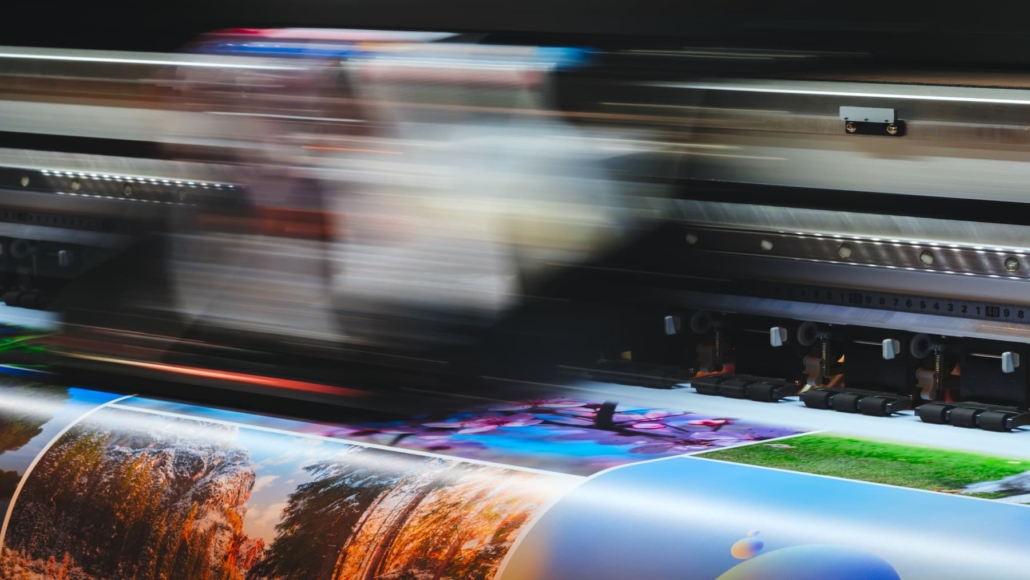
We operate both conventional litho presses (ideal for longer runs) and digital presses (better for shorter runs). We will always quote the most cost-effective and appropriate method for your project specifications.
We operate both conventional litho presses (ideal for longer runs) and digital presses (better for shorter runs). We will always quote the most cost-effective and appropriate method for your project specifications.
Important note for export customers: Digital printing can sometimes result in a higher overall landed cost for overseas shipments. While digital printing may offer advantages for shorter runs, the higher unit cost can have a greater impact on the total cost per copy once production and shipping are combined. We will provide a clear breakdown of production and freight costs to help you choose the most cost-effective solution for your project.
Binding Options.
- Paperback (Perfect Bound): Most common and cost-effective solution.
- Hardback (Casebound): Premium finish available with various cover materials.
- Sewn Binding: Available for projects requiring extra durability and lay-flat qualities.
For hardbacks we can add marker ribbons and head/tail bands as optional enhancements.
Endpapers (Hardbacks) Endpapers bind the book block to the case. Options include:
- Plain (white or cream)
- Coloured (solid colour)
- Printed (CMYK design)
- Printed + Foiled
Finishes.
We offer a full range of finishes to protect and enhance your cover:
- Varnish (Gloss or Matt) – Cost-effective overall protection.
- Lamination (Gloss, Matt, or Soft-Touch) – Durable plastic film with different tactile qualities.
- Spot UV – High-gloss highlights on specific areas (highly effective over matt lamination).
- Foil Blocking – Metallic or coloured foil for elegant accents.
- Embossing / Debossing – Raised or recessed areas for texture and emphasis.
Additional finishes incur extra cost. For runs under 1,000 copies we generally recommend standard varnish or lamination.
File Preparation & Artwork.
Supplying Files Please provide high-resolution print-ready PDF files with the following:
- All fonts embedded
- Images at minimum 300 dpi
- Correct trim size with 3mm bleed where required
- CMYK colour mode (not RGB)
- Single-page spreads in correct consecutive order
Bleeds & Safe Areas
- Any element that runs to the edge of the page must extend 3mm beyond the trim line (bleed).
- Important text and logos should sit at least 4mm inside the trim edge (safe area) to avoid being cut off.
Key points to note
- Page Count / Sides: Count every side of the paper, excluding covers (front and back). For example, a 32-page booklet has 32 sides in total. Page counts must be multiples of 8, 12, 16 or 32 for proper binding.
- Colour vs Mono Pages: You can mix colour and black & white pages. We will calculate the most cost-effective option based on the distribution of colour pages.
- Paper Finishes: We offer gloss, silk and uncoated options. Our team will recommend the most suitable finish for your project based on the printing method and desired appearance.
- Binding: We will advise on the best binding method (perfect bound, hardback, sewn, etc.) according to your page count and requirements.
- Budget: If you have a target budget, please indicate it. This helps us suggest practical options and cost-saving adjustments where possible.
- Additional Information: Use the “Other” field for any special requirements or previous specifications you would like us to consider.
Our team will review your submission and contact you promptly with a clear, competitive quotation and any recommendations.
Quotation Form Guidance.
Once we have your full specifications, we will provide a detailed quotation, usually within 48 hours. Run-on prices are included to help you evaluate different quantities.
Our quotation form is detailed to ensure accuracy, but you do not need to complete every field. The mandatory fields (marked with an asterisk) provide us with enough information to prepare an initial quote.
Common Printing Terms.
Here are some of the most commonly used terms:
- Bleed: Image or colour that extends beyond the trim edge (usually 3mm) to ensure no white borders after cutting.
- Case Binding: High-quality hardback binding where the book block is glued into a rigid cover (usually with a spine and cloth or paper covering).
- CMYK: The four process colours (Cyan, Magenta, Yellow, Black) used in full-colour printing.
- Crop Marks: Lines indicating where the page should be trimmed.
- Die Cutting: Process of cutting custom shapes in paper or board using a steel die (essential for packaging).
- Digital Printing: A modern printing method that prints directly from digital files without plates. Best suited for short runs, variable data, and fast turnaround.
- DPI: Dots Per Inch – a measure of resolution. Higher DPI (e.g. 300 DPI) gives sharper images, especially important for photographs and fine detail.
- Embossing / Debossing: Creating a raised or recessed area on the cover or packaging for tactile effect.
- Foil Blocking: Applying metallic or coloured foil to the cover or packaging using heat and pressure.
- GSM: Grams per square metre – the standard measure of paper weight.
- Halftone: The dot pattern used to reproduce photographs and continuous-tone images.
- Lamination: Thin plastic film applied to covers or packaging for protection and enhanced finish (gloss, matt or soft-touch).
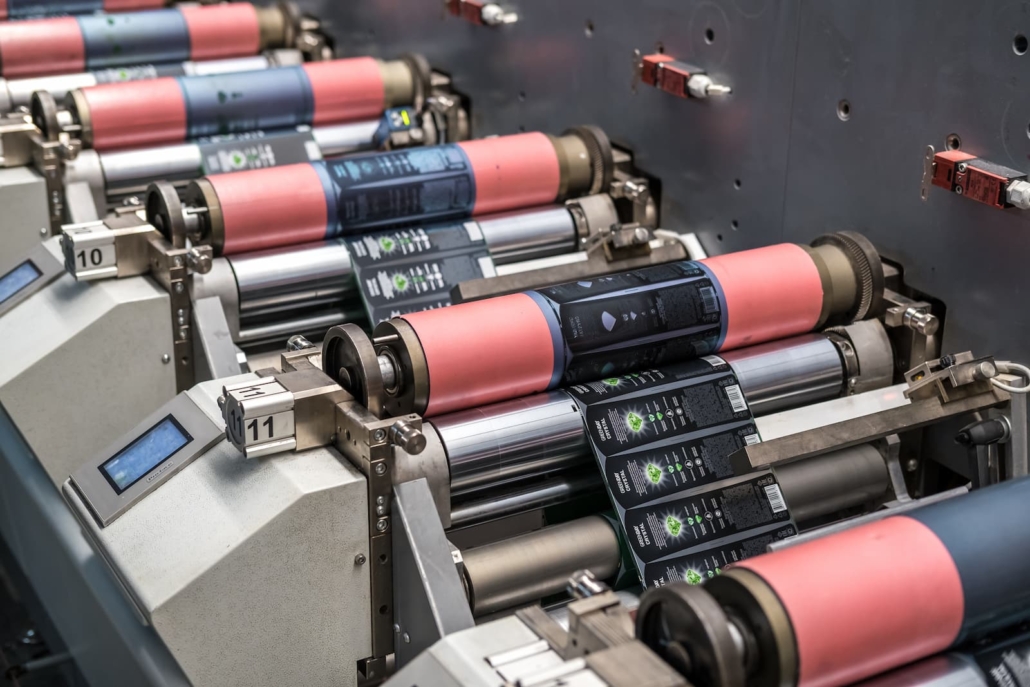
- Offset Printing (Lithography): The most common high-volume printing method where ink is transferred from plates to a rubber blanket and then onto paper. Ideal for large runs with excellent quality and consistency.
- Pantone (PMS): A standardised colour matching system used for precise spot colours that cannot always be achieved with CMYK.
- Perfect Binding: Common paperback binding where pages are glued along the spine.
- Saddle Stitching: Binding method using staples through the spine, commonly used for brochures and magazines.
- Spine Width: The thickness of the spine on a bound book or catalogue. This depends on the number of pages and paper weight.
- Spot UV: High-gloss varnish applied to specific areas for contrast and visual impact.
- Trim Size: The final size of the printed piece after it has been cut to finished dimensions (e.g. 210 × 297 mm for A4).
- Window Patching: Applying a clear plastic window to packaging to display the product inside.
Some key technical considerations:
- Maximum Ink Coverage: Total ink coverage should not exceed 350% on coated boards and 240% on uncoated boards to ensure proper drying and prevent issues with finishing.
- Special Finishes & Materials: Specific design rules apply when using metallic colours, foil blocking, embossing, spot UV, glitter or pile varnishes, holographic foils, Wibalin cloth, or uncoated cover boards. We will recommend the optimal solutions.
- Other Production Requirements: Card tip-ins, stickering, round-and-backed binding, and covers with flaps each have specific technical needs. We will advise on the best solutions for your project to avoid issues during binding and finishing.
By following these guidelines and working closely with our team, you can minimise potential problems before production begins.
Final Steps.
Purchase Order & Payment We require an official purchase order with complete specifications. We operate on a cash-with-order basis for first orders. Books are printed and dispatched once payment is received. Payment terms for returning customers will be established on a case-by-case basis.
Delivery Standard production lead time is 2–3 weeks from final approval of proofs. We offer reliable delivery options across the UK, Europe and beyond, including parcel or pallet shipping depending on quantity and your requirements.
Join Our
Journey Today.
Be part of a company where precision meets creativity, and where every role contributes to delivering excellence.